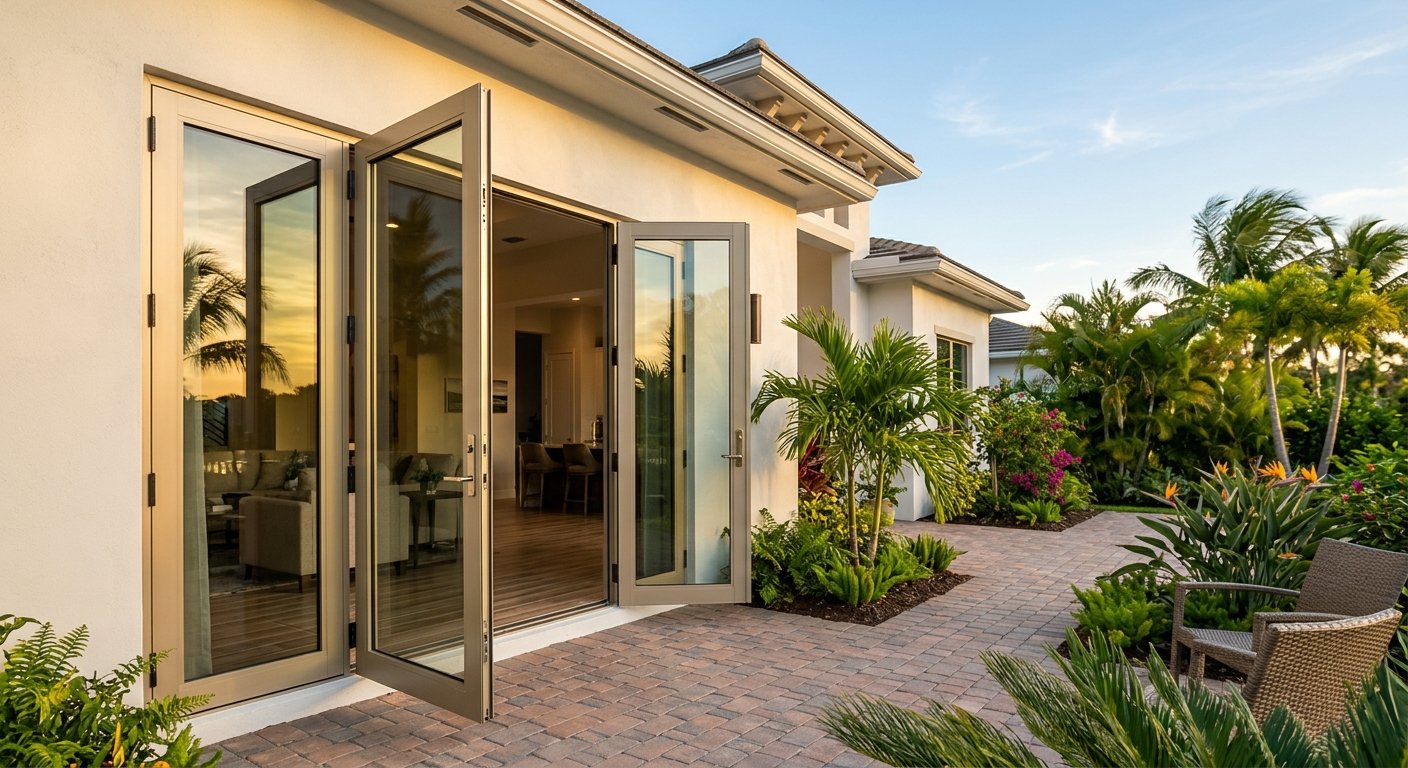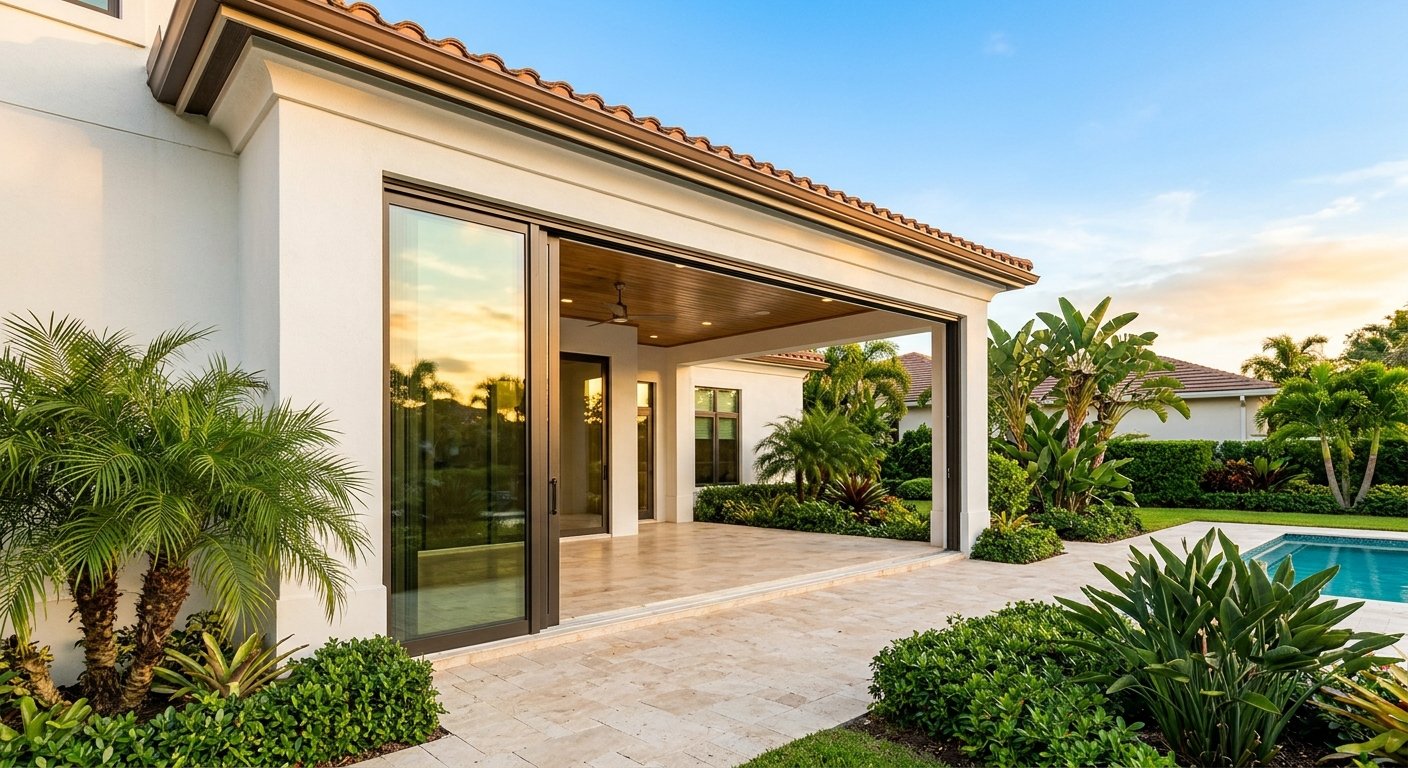
For South Florida homeowners choosing between aluminum and vinyl impact window frames, the short answer is: both materials can carry a valid Florida Product Approval, and both perform well in our climate — but they behave differently in salt air, thermal cycling, and demanding coastal environments. The right choice depends on your home’s design, proximity to saltwater, and performance priorities.
- Both aluminum and vinyl frames are available with Florida Product Approval or Miami-Dade NOA — approval number on every quote is non-negotiable.
- Aluminum offers narrower sightlines, greater structural rigidity, and long-term dimensional stability in direct sun and salt air.
- Vinyl frames provide better thermal break performance out of the box, reducing conductive heat transfer through the frame itself.
- Salt-air exposure (within roughly a mile of open water) tips the scale toward aluminum with a proper factory finish or toward premium vinyl — your installer should be specific about the product’s corrosion testing.
- Frame material affects curb appeal, maintenance, and long-term performance — it does not change the permitting process or the need for a licensed contractor.
Why Frame Material Matters Beyond the Glass
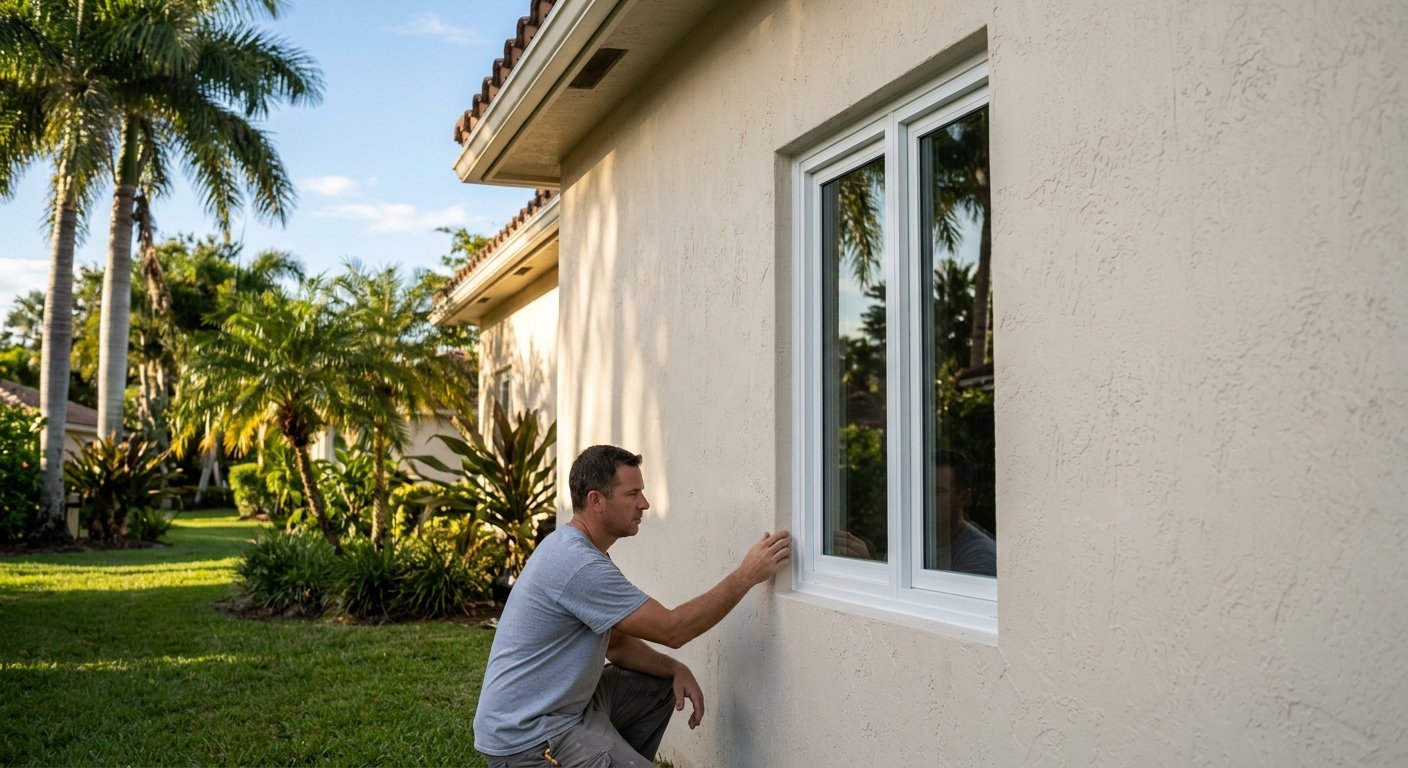
When homeowners compare impact windows, the laminated glass unit gets most of the attention — and rightly so. But the frame does more than hold the glass in place. It carries the structural load from wind pressure into the wall, maintains the air and water seal that keeps South Florida weather outside, and either holds its shape or gradually distorts over years of intense sun, salt, and humidity.
In Palm Beach County, Broward County, and the Fort Myers and Naples corridor, those conditions are some of the most demanding in North America. Thermal cycling — the daily expansion and contraction caused by intense solar heat — stresses frame joints. Salt-laden air corrodes metal if the finish is inadequate. And Florida’s humidity means any moisture that infiltrates a compromised frame joint creates problems over time. Understanding how aluminum and vinyl each handle these conditions is the starting point for a sound decision.
Florida Product Approval isn’t just a checkbox — it means the specific frame and glass combination was tested as a system and passed Florida’s structural, water-infiltration, and forced-entry standards. When you ask for the approval number on your quote, you’re confirming the entire assembly was validated, not just the glass unit alone.
Aluminum Frames: Performance Profile for Coastal Florida
Structural Rigidity and Slim Sightlines
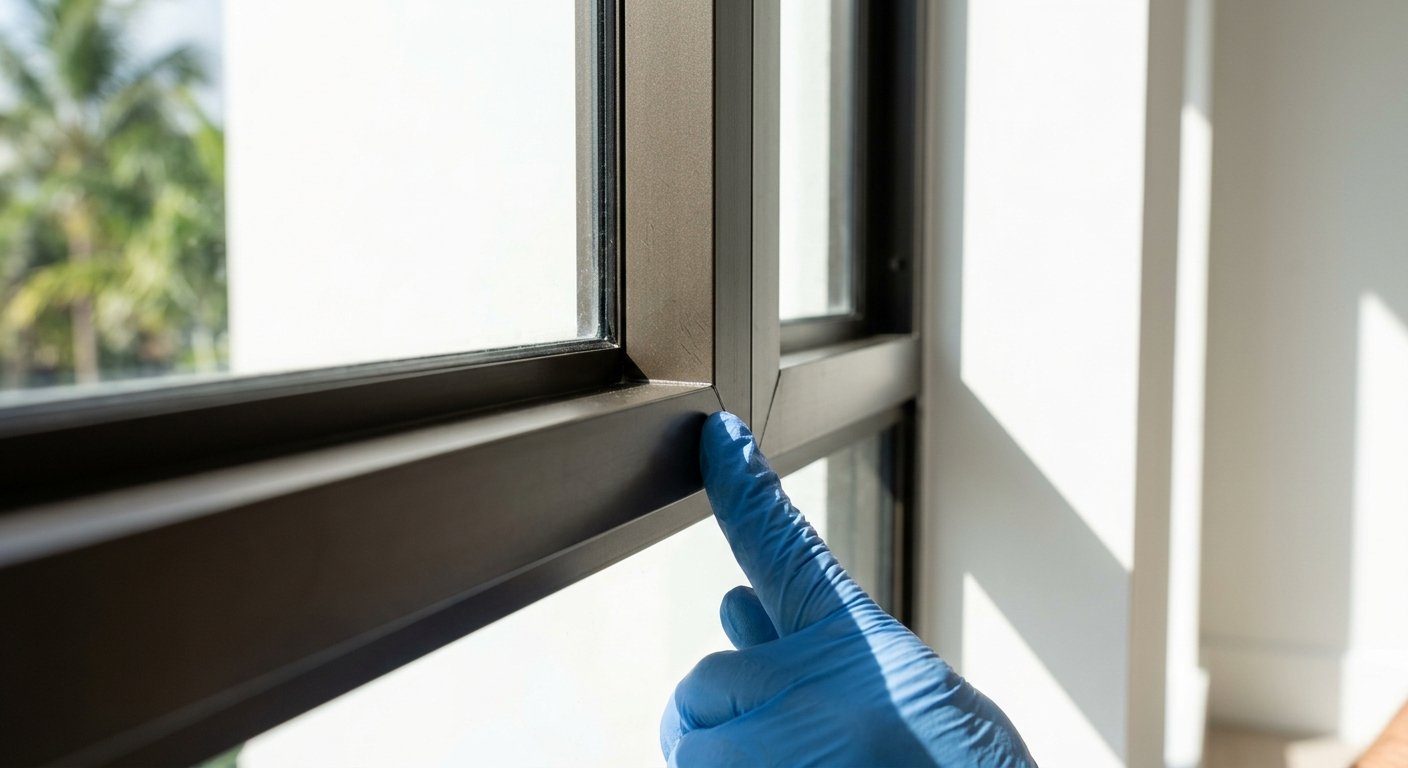
Aluminum is roughly three times stiffer than vinyl by weight, which allows manufacturers to engineer narrower frame profiles. For homes in Palm Beach Gardens, Coral Springs, or Cape Coral where large architectural openings and minimal sightlines are part of the design intent, aluminum frames deliver a cleaner aesthetic while still meeting the structural demands the product approval requires.
That rigidity also means aluminum frames maintain their geometry over time. In South Florida’s climate, where daily temperatures can swing significantly and direct sun exposure is relentless, frames that hold their dimension year after year produce consistent seal performance at the perimeter — which is where water infiltration problems almost always begin.
Corrosion in Salt Air
Aluminum’s real vulnerability in coastal environments is galvanic corrosion — particularly at fasteners and where the frame contacts dissimilar metals. Quality impact window manufacturers address this with multi-stage factory finishing, anodizing, or powder-coat systems tested for salt-spray exposure. The Florida Building Commission requires that products carry documented test results supporting their approval, so the corrosion performance of any approved product has been part of that evaluation.
For homes in Lighthouse Point, Boca Raton beachfront, or along the Fort Myers Beach corridor — anywhere within a close distance of open saltwater — specifying the right aluminum finish matters. This is a question worth asking your installer to answer specifically, not generically.
Thermal Conductivity
Aluminum conducts heat readily. Without a thermal break — a polyamide or polyurethane strip separating the interior and exterior aluminum sections — the frame itself becomes a path for heat to enter the conditioned space. Better-performing aluminum impact window systems use thermally broken frames, which significantly reduces this conductive transfer. When reviewing product approvals and specifications from authorized manufacturers like CWS or ES Windows, the frame construction detail is part of the documented system.
Vinyl Frames: Performance Profile for South Florida

Thermal Performance Out of the Box
Vinyl (PVC) is an inherently poor conductor of heat relative to aluminum. Multi-chamber vinyl frame profiles — where the frame cross-section contains several hollow chambers separated by PVC walls — create natural thermal resistance without requiring a separate thermal break component. For homeowners in Weston, Wellington, or Naples who are focused on keeping cooling loads down, vinyl frames offer meaningful performance at the frame level, complementing the Low-E coating on the glass unit itself.
Corrosion Resistance and Maintenance
Vinyl does not corrode. For properties in Boynton Beach waterfront communities, Delray Beach coastal neighborhoods, or along the Caloosahatchee in Fort Myers, that is a genuine long-term maintenance advantage. The frame surface does not pit, oxidize, or require periodic refinishing. It can be wiped clean and returns to its original condition without sanding or repainting.
The trade-off is color limitation. Standard vinyl impact windows are available in white, tan, and a limited range of earth tones. Custom color matching — a common request on Spanish-Mediterranean architecture in Coral Springs or Parkland — is generally not available in vinyl. Aluminum can be powder-coated to virtually any color and can be matched to existing trim or fenestration on a home.
Dimensional Stability Under Florida Sun
This is where vinyl requires scrutiny. PVC expands and contracts more than aluminum per degree of temperature change. In a mild climate that is a non-issue, but South Florida rooftop and direct-west exposure can heat frame surfaces to temperatures well above ambient air. Quality vinyl impact window profiles are engineered with reinforcement — typically galvanized steel or aluminum inserts — inside the main frame members to limit this movement. Without that reinforcement, frame geometry can shift over time and compromise the perimeter seal.
When reviewing product specifications, ask whether the vinyl frames include internal reinforcement. Any product carrying a valid Florida Product Approval will have survived the test protocol, but reinforcement detail tells you something about long-term durability beyond the initial test window.
| Performance factor | Aluminum | Vinyl |
|---|---|---|
| Structural rigidity | High — narrow sightlines possible | Moderate — reinforcement recommended |
| Thermal conductivity | High without thermal break; low with one | Low — multi-chamber PVC resists transfer |
| Salt-air corrosion | Requires quality finish / anodizing | Not susceptible |
| Color options | Broad — powder-coat to spec | Limited — white, tan, standard tones |
| Maintenance | Inspect finish; recoat if needed | Low — wipe clean, no refinishing |
| Long-term dimensional stability | Excellent | Good with internal reinforcement |
| Florida Product Approval available | Yes | Yes |
What the Permitting Process Actually Requires
Whether you choose aluminum or vinyl frames, the permitting process in Palm Beach, Broward, Lee, and Collier counties is the same: the product must carry a valid Florida Product Approval or Miami-Dade NOA for the specific frame-and-glass assembly, the contractor must pull a permit before work begins, and the installation must pass a final building department inspection. Frame material does not simplify or complicate the permit — the approval documentation does the work.
At Access Impact, every quote lists the Florida Product Approval or NOA number for the specific product being proposed. We pull every permit, and our permit passing guarantee means we carry the job through final inspection with our in-house crews. We are a Florida Certified General Contractor (CGC1525402) — not a broker or volume reseller arranging day-labor subcontractors. The installation quality that determines whether a job passes inspection is built into how we work, not promised after the fact.
If you are researching the full impact window installation process, that page covers scope, timeline, and what to expect from contract through final inspection.
Ask your installer to provide the Florida Product Approval number for the specific frame-and-glass combination before you sign anything. Cross-reference it at the Florida Building Commission’s product approval search at floridabuilding.org to confirm the approval is current and covers your county’s requirements. A legitimate installer will give you this number without hesitation.
Which Frame Material Suits Your Home?
There is no universal answer, but here is a practical framework based on the homes and properties we see across Palm Beach, Broward, Lee, and Collier counties:
- Beachfront or waterfront within a mile of open saltwater: Quality aluminum with premium corrosion-resistant finish, or premium vinyl with internal reinforcement. The choice depends more on the specific product’s corrosion test documentation than on the material category alone.
- Inland or suburban homes in Coral Springs, West Palm Beach, Davie, or Fort Myers: Both materials perform well. Vinyl often makes sense for thermal performance; aluminum for color-matching or large-opening applications.
- Architecturally demanding homes with large fixed or casement units: Aluminum’s structural depth handles span requirements that challenge vinyl profiles without heavy reinforcement.
- Homes seeking minimal exterior maintenance: Vinyl’s corrosion immunity and simple cleaning routine have a genuine long-term advantage.
Impact doors — whether sliding glass, French, or pivot configurations — follow a similar material logic, though door applications involve heavier panels and more demanding structural requirements where aluminum’s rigidity often leads the specification.
The frame carries the load, holds the seal, and determines what your windows look like in twenty years — it deserves the same scrutiny as the glass.
Frequently Asked Questions
Does frame material — aluminum or vinyl — affect whether my impact windows pass inspection?
Frame material itself does not determine inspection outcome. What matters is that the frame-and-glass assembly carries a valid Florida Product Approval or Miami-Dade NOA for the opening it fills, that the permit was pulled before installation, and that the installation follows the approval’s listed instructions. A properly installed vinyl or aluminum system both pass inspection when the work is done correctly.
Are vinyl impact window frames suitable for direct oceanfront homes in Palm Beach or Broward County?
Yes — quality vinyl frames are not susceptible to corrosion, which is an advantage in salt air. The more important questions for any oceanfront application are whether the product’s approval covers the structural demands of your specific opening and whether the vinyl profiles include internal reinforcement for dimensional stability under intense direct sun exposure.
Can aluminum impact window frames be matched to custom paint colors?
Yes. Aluminum frames can be powder-coated to a wide range of colors, including custom specifications to match existing trim, shutters, or architectural features. This is one of aluminum’s practical advantages over vinyl, which is generally available in white, tan, and a limited selection of standard tones.
What is a thermal break in an aluminum impact window frame, and do I need one?
A thermal break is a non-metallic insert — typically polyamide — that separates the interior and exterior aluminum sections of the frame, interrupting the conductive heat path through the metal. In South Florida’s climate, where cooling loads are significant and air conditioning runs most of the year, thermally broken aluminum frames perform substantially better from an energy standpoint than non-broken aluminum. Whether your specific product uses one is documented in its Florida Product Approval specification sheet.
Does the Florida Product Approval process cover both aluminum and vinyl frames equally?
Yes. The Florida Product Approval system evaluates the complete window or door system — frame, glass, hardware, and installation method — regardless of frame material. Both aluminum and vinyl systems are tested against the same structural, water-infiltration, and forced-entry standards. The approval number on a product confirms it passed those tests as an assembly, not just the glass unit in isolation.
Get a Frame-Specific Quote for Your Home
Access Impact installs impact windows across Palm Beach, Broward, Lee, and Collier counties — with Florida Product Approval on every product, in-house crews, and a permit passing guarantee. Contact us to discuss aluminum vs. vinyl options for your specific home and opening configuration.

About Access Impact
Access Impact is a licensed Florida general contractor (CGC1525402) and roofing contractor (CCC1337755) installing impact windows and impact doors across Palm Beach County, Broward County, and Southwest Florida (Lee and Collier) since 2007, and now roofing as well. In-house crews, Florida Product Approval on every product, and a permit-passing guarantee: the technically authoritative installer, not a volume reseller. Windows and doors are CWS and ES Windows; roofing is CertainTeed, Owens Corning, GAF, Dynamic Metals, Metal Alliance, and Polyglass. Offices in Deerfield Beach and Fort Myers. Visit accessimpact.com →