Comparing impact window bids in South Florida comes down to five things: verifiable contractor licenses, Florida Product Approval numbers on every product, a clear permit line item, named manufacturers, and an installation crew that belongs to the company. A quote missing any of these is not just incomplete — it can cost you a failed inspection or an out-of-pocket reinstall.
- Verify every contractor’s Florida CGC or CBC license at myfloridalicense.com before signing anything.
- Every product on the quote must list a Florida Product Approval or Miami-Dade NOA number — no number, no approval.
- Permits are not optional; a bid that omits them or buries them in fine print is a red flag.
- The manufacturer name matters: make sure the quote names the brand being installed, not a generic description.
- Compare scopes line by line — a lower total price often reflects a narrower scope, not a better deal.
Why Bid Comparisons Go Wrong
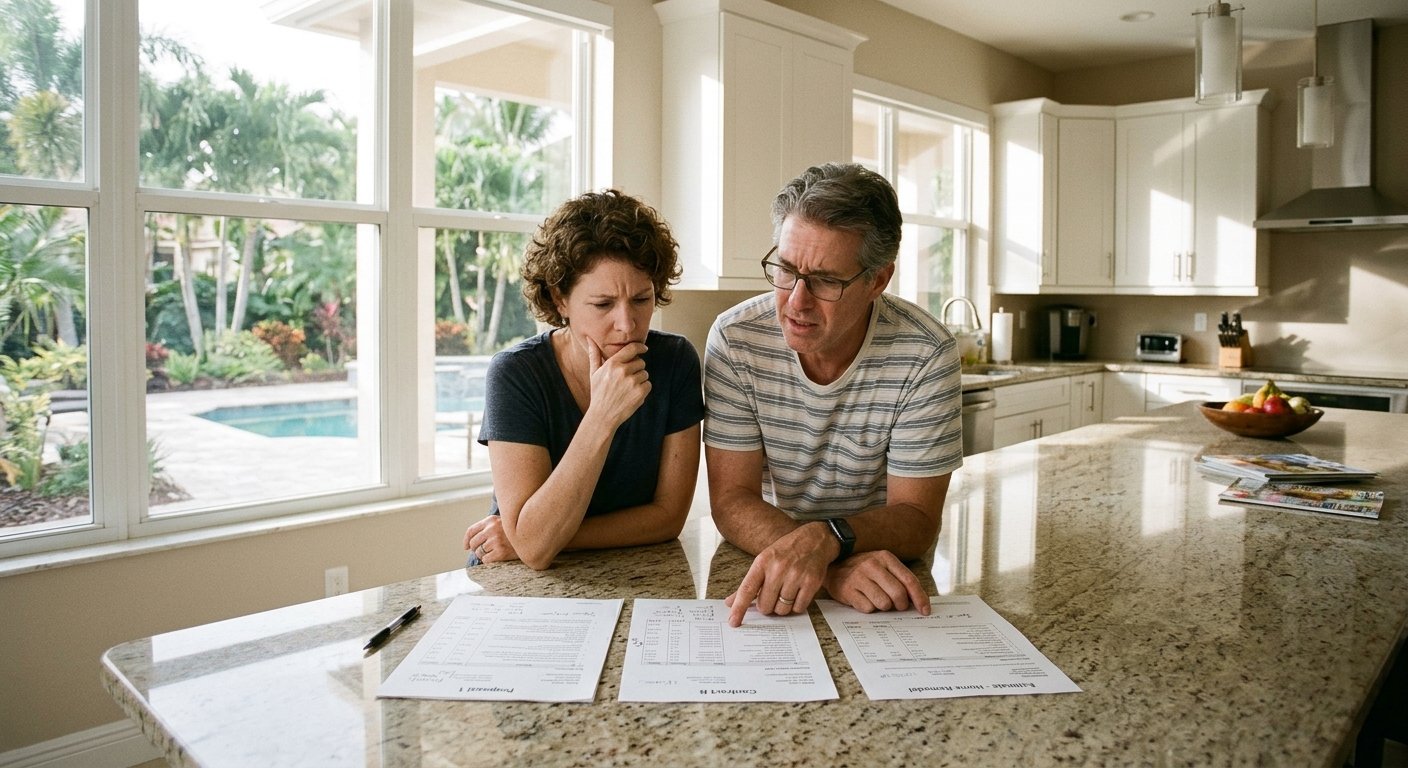
Most homeowners in Boca Raton, Naples, or Fort Lauderdale collect two or three bids and compare the bottom-line totals. That approach misses almost everything that matters. Two quotes for “impact windows throughout” can describe completely different projects — different glass specifications, different frame materials, different manufacturers, and a wildly different level of permitting included. Comparing totals without comparing scopes is like comparing two restaurant bills without looking at what was ordered.
The good news: once you know what each line item should say, reading a bid becomes straightforward. The sections below walk through each piece in order.
Step 1 — Confirm the Contractor’s Licenses
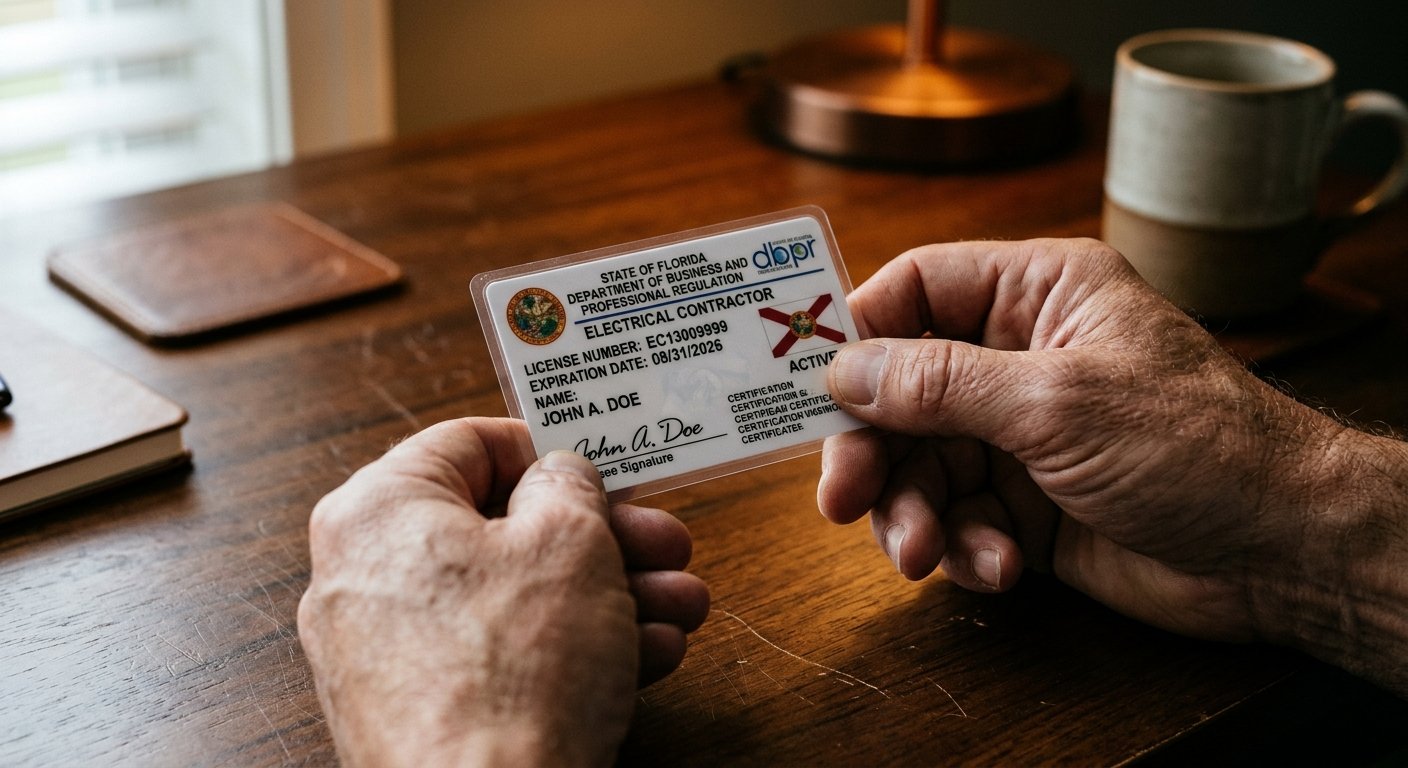
In Florida, installing impact windows and doors in a residential structure requires either a Certified General Contractor (CGC) or a Certified Building Contractor (CBC) license issued by the Florida Department of Business and Professional Regulation. A roofing-only license (CCC) does not cover window or door installation. Any contractor who cannot produce a license number for verification should be removed from your list immediately.
Look up the license number at the DBPR licensee search. Confirm the license is active, the name on the license matches the company name on the contract, and there are no open disciplinary actions. This step takes three minutes and eliminates a significant amount of risk.
Access Impact holds Florida Certified General Contractor license CGC1525402 and Certified Roofing Contractor license CCC1337755 — both verifiable on the DBPR site. Both licenses cover the work we quote.
Some contractors list a license number on their letterhead that belongs to a qualifier who no longer works for the company. Always verify the name and status on the DBPR database, not just the number on the bid.
Step 2 — Check Every Product Approval Number

Florida law requires that impact windows and doors carry a Florida Product Approval (FPA) or a Miami-Dade Notice of Acceptance (NOA) before they can be permitted and installed. The Florida Building Commission’s product approval search lets you look up any approval number in seconds. If a bid lists a window brand but no approval number, ask for it in writing before you proceed. If the contractor cannot produce one, that product has not been evaluated for your county’s code requirements.
A complete bid line item for a window looks something like this: manufacturer name, product series, frame material (aluminum or vinyl), glass type (laminated, Low-E laminated), and the Florida Product Approval or NOA number. Anything less than that is a description, not a specification.
At Access Impact, every quote lists the Florida Product Approval or Miami-Dade NOA number for every product. We install CWS and ES Windows product lines — both hold current approvals — and we can walk you through the approval documents before you sign.
If you are comparing bids that reference different manufacturers, look up each product’s approval number and confirm it is approved for your county. Approvals can be county-specific, and a product approved for one jurisdiction may not be listed for another.
Step 3 — Understand the Frame Material Trade-Off
Aluminum and vinyl frames behave differently in South Florida’s salt air and sun. Aluminum is dimensionally stable, handles larger openings well, and is the standard for commercial applications in Palm Beach Gardens, Fort Myers, or Coral Springs. Vinyl has lower thermal conductivity, which reduces heat transfer through the frame itself. Neither is categorically superior — the right choice depends on your home’s design, opening sizes, and exposure to salt spray. For a deeper look at how these materials compare in real-world conditions, see this comparison of aluminum vs. vinyl impact window frames.
When reviewing bids, confirm the frame material is explicitly named. A quote that says “impact windows” without specifying frame material leaves room for substitution after you sign.
| What to compare | Aluminum frames | Vinyl frames |
|---|---|---|
| Salt-air durability | Anodized or painted finishes resist corrosion | Not susceptible to corrosion; color is integral |
| Thermal performance | Conducts more heat through frame | Lower thermal conductivity |
| Large openings | Handles wider spans well | Better suited for standard residential sizes |
| Typical application | Commercial, contemporary residential | Residential; cost-effective for many homes |
| Finish options | Wide range of anodized and painted colors | Standard white, tan, and select custom colors |
Step 4 — Verify the Permit Is Included
Impact window installation in Palm Beach County, Broward County, Lee County, and Collier County all require a permit. The permit triggers inspections that confirm the installation meets the Florida Building Code. A quote that does not include permit fees — or buries them as “homeowner’s responsibility” — is not a complete quote. You are comparing different scopes.
Ask each contractor directly: “Do you pull the permit, and is the permit fee in this number?” The answer should be yes to both. Understand what happens if an inspection requires a correction — who pays and who shows up. A contractor with in-house crews who stands behind a permit-passing guarantee has skin in the game; a volume reseller who subcontracts the work may not.
Access Impact pulls every permit, carries each project through final inspection, and backs that with a permit-passing guarantee. Our in-house crews — no day-labor subcontractors — are on the job from demolition through final walk-through. That continuity matters at inspection time. For more on how the inspection process works, see what happens during a Florida Building Code impact window inspection.
Verify licenses
Look up every contractor on the DBPR licensee search. Active license, matching name, no violations.
Confirm product approvals
Every product on the bid should have a Florida Product Approval or Miami-Dade NOA number you can look up on floridabuilding.org.
Compare scopes, not totals
Line up each quote side by side: manufacturer, frame material, glass type, number of openings, and permit included vs. excluded.
Ask about the crew
Will the same company that signs the contract install the windows, or will the work be handed to a subcontractor?
Confirm the timeline
A realistic timeline for impact window installation from signed contract to completed installation is 10–12 weeks, accounting for permit processing and product lead time.
Step 5 — Read the Red Flags
Several patterns in a bid signal trouble before the project ever starts. Watch for these specifically:
- No manufacturer named. “Impact-grade windows” or “Florida-approved glass” without a brand name is not a specification. You have no way to verify approval or hold anyone accountable to a specific product.
- Permit listed as optional or owner-provided. Permits are not optional in any county we serve. A contractor who suggests otherwise is either uninformed or planning to skip the inspection process.
- Unlicensed subcontractors. Ask directly whether the installers are in-house crews or day-labor subcontractors. The answer affects accountability, workmanship, and what happens if something goes wrong.
- A suspiciously fast timeline. Rushing permit processing is not possible — municipal and county review takes the time it takes. A contractor promising installation in two or three weeks may be planning to start without a permit.
- No written scope of work. If the bid is a single-line total with no itemized breakdown, you have no way to know what is and is not included. Never sign a contract without a written scope.
A quote missing a product approval number is not a complete bid — it is an estimate for a product that may not meet your county’s code requirements.
For homeowners in West Palm Beach and the surrounding Palm Beach County area, the 2026 impact window installation guide for West Palm Beach covers local permit and inspection specifics worth reviewing before you sign any contract.
Frequently Asked Questions
How long does impact window installation take from contract to completion?
Typically 10–12 weeks from a signed contract to completed installation. That window accounts for permit application and municipal review, product fabrication lead time, and scheduling the installation crew. Any bid that promises significantly faster turnaround should be questioned — permit processing timelines are set by the county or city, not the contractor.
What is a Florida Product Approval and why does it matter?
A Florida Product Approval (FPA) is an evaluation issued by the Florida Building Commission confirming that a specific window or door product meets the state’s building code requirements. Without a valid FPA or Miami-Dade NOA, the product cannot legally be permitted or installed in Florida. Every product on your quote should include the approval number so you can verify it at floridabuilding.org before signing.
Should I get multiple bids for impact window installation?
Yes — but compare scopes, not just totals. Three bids with different products, different permit inclusions, and different crew structures are not three prices for the same job. Use the line-item checklist in this article to normalize the quotes before drawing any conclusions about price.
What happens if an impact window installation fails inspection?
The contractor is required to correct the deficiency and schedule a re-inspection. A contractor who backs a permit-passing guarantee and uses in-house crews handles corrections at no additional cost to the homeowner. This is one of the most important questions to ask before signing: “What is your process if a correction notice is issued?” Get the answer in writing.
Does the installer need to be the same company that pulls the permit?
Yes. The licensed contractor who signs the permit application is responsible for the work done under that permit. If a company pulls a permit and then hands the installation to an unlicensed subcontractor, that arrangement violates Florida contractor licensing law. Confirm that the company signing your contract is also the company whose crews will install the windows.
Getting a Quote That Stands Up to Scrutiny
Access Impact has been installing impact windows, impact doors, and roofing across Palm Beach County, Broward County, and Southwest Florida since 2007 — more than 2,000 installations completed by in-house crews under Florida Certified General Contractor license CGC1525402. Every quote we provide includes the manufacturer name, Florida Product Approval or NOA number, frame and glass specification, permit fee, and a permit-passing guarantee. Nothing is hidden in fine print.
If you are comparing professional impact window installation contractors and want a quote that gives you something real to compare against, we are straightforward to work with. Ask us for the product approval numbers upfront. We will provide them. For a broader look at the full installation process, visit our impact window installation overview, or explore impact door installation if you are also replacing entry or sliding doors.
Get a bid worth comparing
Request a written quote with full product specifications, approval numbers, and permit fees — no guesswork, no fine print.

About Access Impact
Access Impact is a licensed Florida general contractor (CGC1525402) and roofing contractor (CCC1337755) installing impact windows, impact doors, and roofing across Palm Beach County, Broward County, and Southwest Florida (Lee and Collier) since 2007. In-house crews, Florida Product Approval on every product, and a permit-passing guarantee: the technically authoritative installer, not a volume reseller. Windows and doors are CWS and ES Windows; roofing is CertainTeed, Owens Corning, GAF, Dynamic Metals, Metal Alliance, and Polyglass. Offices in Deerfield Beach and Fort Myers. Visit accessimpact.com →