If you’re replacing one impact door at a time, prioritize your front entry door first — it’s your home’s primary breach point, handles the most daily use, and typically requires more complex permitting and framing work than a sliding glass door replacement. That said, the right answer depends on your home’s current code compliance, which opening shows wear or damage, and how each door is used.
- Front entry doors face more structural and security demand — replace them first if both openings need work.
- Impact sliding doors offer superior glass area and natural light but are usually a secondary priority unless the existing slider is severely compromised.
- Both door types require Florida Product Approval and a pulled permit — never skip either step.
- The 10–12 week lead time from contract to installation applies to both door types; plan accordingly.
- A licensed contractor with in-house crews handles the permitting, product approval verification, and installation as a single process — not three separate vendor relationships.
Why the Front Door Usually Comes First
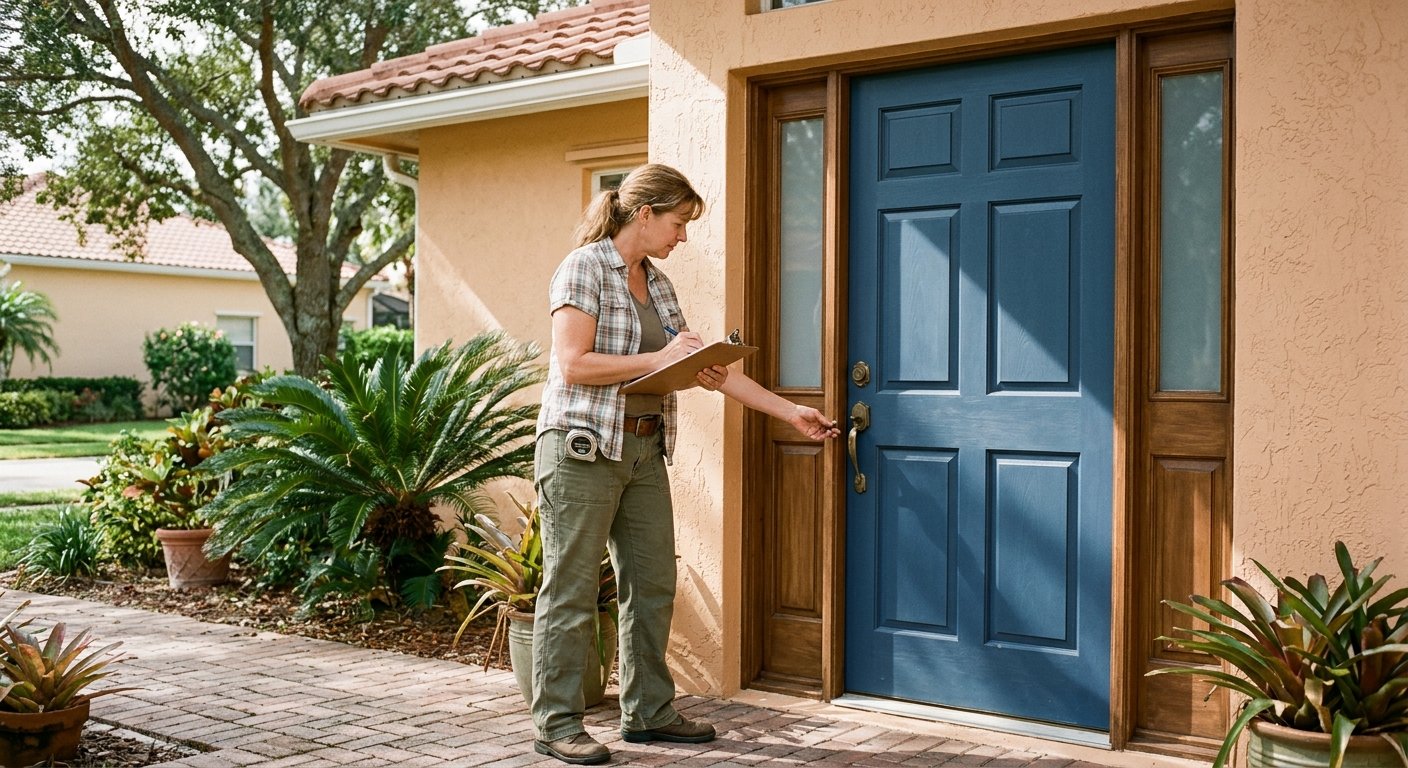
Your front entry door is a primary structural opening. It bears the most daily mechanical stress — locking, slamming, foot traffic — and it’s typically set into a framed rough opening that was engineered for a specific door size and swing. When that door is out of code compliance, whether it’s an old wood door with inadequate glazing or a fiberglass unit without a Florida Product Approval number, the entire opening is non-compliant under the Florida Building Code.
For homeowners in Boca Raton, Boynton Beach, Fort Lauderdale, or anywhere else in Broward or Palm Beach County, replacing a non-compliant front door first also tends to produce the most visible result: better security hardware, improved weather sealing around the frame, and a cleaner look at the most-inspected part of your home during a real estate transaction or insurance appraisal.
Every impact door installed in Florida must carry a Florida Product Approval (or Miami-Dade NOA for that county’s jurisdiction). This approval is tied to the specific product, size, and installation method — not just the brand. At Access Impact, we verify product approvals before every quote and include permit passing as a guarantee on every job.
What Makes Impact Front Doors Different

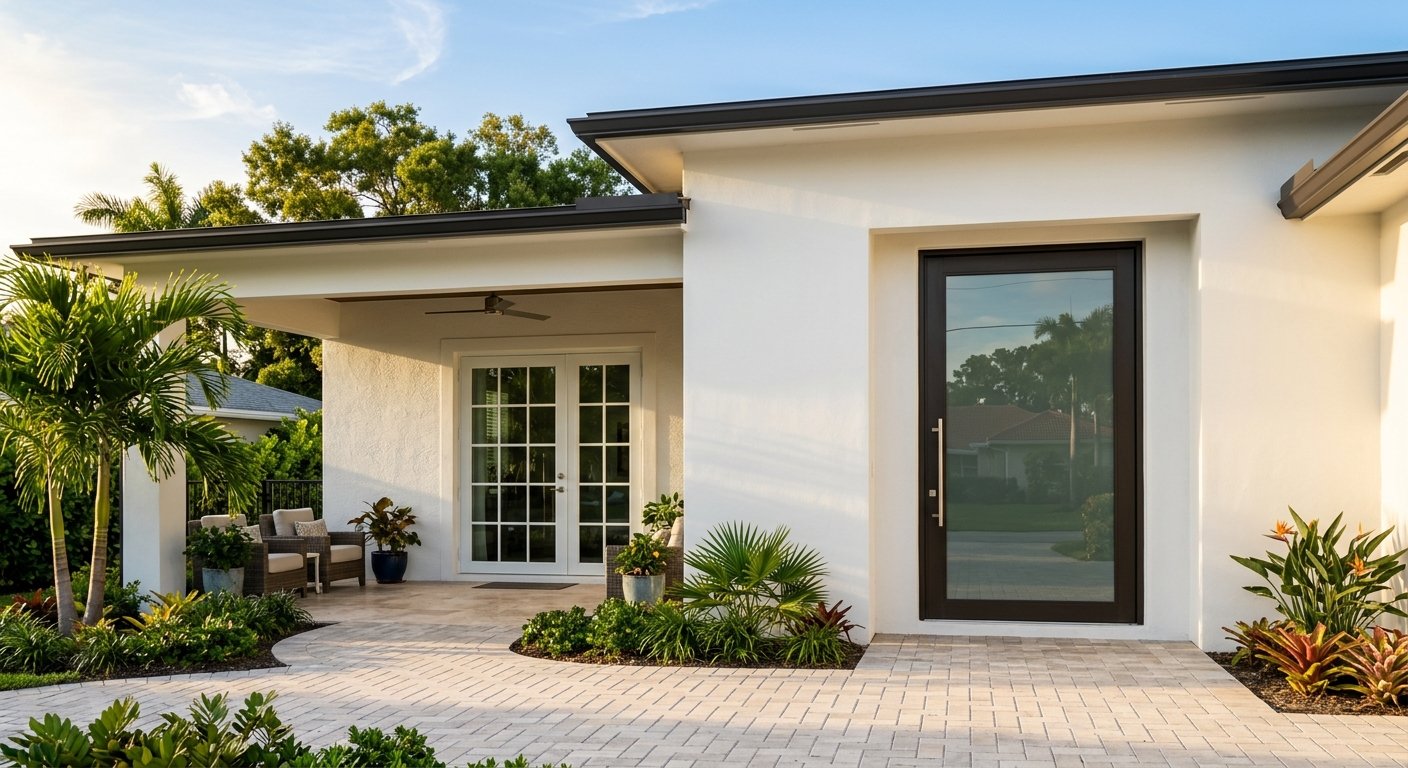
Impact-rated entry doors — including French and pivot configurations — use laminated glass panels or solid-core construction with impact-rated glazing where glass is present. The door frame, hardware, and attachment method to the rough opening all factor into the product approval and the installation inspection.
Pivot doors, in particular, are structurally distinct: the weight transfers through floor and ceiling pivot points rather than hinges, which changes the rough opening requirements and the permit drawings entirely. Our pivot impact door installations require custom rough opening verification before any product is ordered.
French doors present a different consideration: paired panels with a center astragal, each panel independently tested under the Florida Product Approval system. Mismatched installation — correct door, incorrect frame anchor pattern — is one of the most common reasons impact door installations fail inspection. In-house crews who’ve installed across Palm Beach Gardens, Wellington, Jupiter, and Cape Coral know these county-specific inspection patterns. Day-labor subcontractors don’t carry that institutional knowledge.
The Case for Replacing the Sliding Door First

There are real scenarios where the impact sliding glass door takes priority. If your existing sliding patio door is a 1980s or 1990s aluminum slider with single-pane glass, it’s not just non-compliant — it’s a significant thermal and acoustic liability. Laminated low-E glass in a modern impact sliding door reduces solar heat gain and dampens outside noise in ways that single-pane glass simply cannot match.
Sliding doors also tend to cover larger glass areas than entry doors, which means the performance differential between old and new is more immediately noticeable. Homeowners in Weston, Plantation, or Naples who spend significant time near a rear patio or pool deck will feel that difference daily.
The right door to replace first is the one that’s most out of compliance or most compromised — not necessarily the one that’s most visible from the street.
Impact sliding door replacement also tends to be more straightforward from a framing standpoint. Most sliding glass door openings were built to accept replacement-in-kind units, which simplifies the permit drawings and shortens the inspector’s checklist. That doesn’t mean it’s simple — it means the variables are more predictable when the rough opening is already sized correctly.
| Factor | Impact Front Entry Door | Impact Sliding Glass Door |
|---|---|---|
| Structural complexity | Higher — hinge, frame, and lock hardware all inspected | Moderate — track system and frame anchoring |
| Glass area | Smaller, often with solid panel options | Larger — more solar and acoustic benefit |
| Permit complexity | Higher for pivot and French configurations | Generally more predictable for standard widths |
| Daily use stress | High — primary entry point | Lower — secondary or patio access |
| Code priority if non-compliant | High — primary breach point | High — large glazed area without approval is a liability |
| Curb appeal impact | Immediate — first impression | Backyard or interior-facing |
How to Make the Decision: A Practical Framework
Before choosing which door to replace first, answer these questions honestly:
- Is either door currently permitted and code-compliant? If one door lacks a Florida Product Approval and the other is a permitted impact unit, replace the non-compliant door first regardless of location.
- Is there visible damage, failed seals, or operational issues? A sliding door with a bent track, broken rollers, or fogged glass is a functional failure — it moves to the front of the line.
- Is the front door the only barrier between your living space and the exterior? Some homes have a covered entry vestibule or impact-rated storm screen. Others have only the door. The latter prioritizes the entry door upgrade.
- Are you planning to sell or refinance within two to three years? Curb appeal and code compliance documentation both favor the front door as the first project.
If budget allows, schedule both doors in the same contract. The permitting process covers both openings simultaneously, the inspection is combined, and the lead time — typically 10–12 weeks from contract to installation — runs once instead of twice. You save calendar time even if the installations happen in separate phases.
What the Installation Process Looks Like
Site measurement and product selection
Rough opening dimensions, wall thickness, and existing frame condition are documented. Product selection — including CWS or ES Windows door lines — is matched to the opening and the Florida Product Approval required for your county.
Permit application
Access Impact pulls the permit directly, submitting product approval documentation, drawings, and site information. Homeowners in Coral Springs, Pompano Beach, or Fort Myers don’t have to manage this step.
Product fabrication and delivery
Impact doors are manufactured to your specific opening dimensions. The 10–12 week window from contract to installation reflects this fabrication timeline.
In-house crew installation
Access Impact uses in-house crews — no day-labor subcontractors. The same team that knows your permit file installs the door and preps for inspection.
Inspection and permit close
The county inspector reviews the installation against the permit drawings and product approval. Access Impact’s permit passing guarantee means we stand behind every installation through final sign-off.
Frequently Asked Questions
Can I replace just one impact door without replacing the other openings?
Yes. Florida Building Code does not require you to replace all openings simultaneously. Each door replacement is permitted and inspected independently. That said, combining projects in a single contract is more efficient from a permitting and scheduling standpoint.
Do impact sliding glass doors and front entry doors use the same product approval process?
Both require Florida Product Approval under the Florida Building Commission’s product approval system, but the approval is specific to each product’s configuration, size, and installation method. A sliding door approval does not transfer to an entry door, and vice versa. Access Impact verifies both approvals before any job is quoted.
How long does impact door installation take once the product arrives?
Most single-door installations are completed in one day by an in-house crew. Larger or more complex configurations — wide sliding doors, paired French units, or pivot doors with custom rough openings — may take two days. The longer timeline is the 10–12 weeks between contract signing and installation day, which reflects fabrication lead time.
What’s the difference between an impact door and a standard door with a storm shutter?
An impact door uses laminated glass and a tested frame system that together carry a Florida Product Approval as a single unit. A standard door with a separate storm shutter is two independent products — neither is approved as an impact-rated system on its own. Building departments in Palm Beach County and Broward County require the integrated impact-rated system for compliance.
Is pricing for front entry doors and sliding glass doors similar?
Pricing varies based on opening size, configuration, glass type, and hardware — not a simple door-type comparison. Access Impact provides quotes only after a site measurement; we don’t publish price ranges because they don’t reflect real-world variables accurately.
Why Contractor Selection Matters Here
Impact door installation — whether a front entry or a sliding patio door — touches structural framing, waterproofing, code compliance, and permit documentation simultaneously. The Florida Department of Business and Professional Regulation licenses contractors specifically because this work requires verified competency, not just labor availability.
Access Impact holds Florida Certified General Contractor license CGC1525402 and Florida Certified Roofing Contractor license CCC1337755. We’ve been installing impact doors across Palm Beach County, Broward County, and Southwest Florida since 2007, with 2,000+ installations completed by in-house crews. Our full impact door line — including French, sliding, and pivot configurations — is covered at our impact door installation page. If you’re also evaluating impact windows for adjacent openings, our impact window installation page walks through that process in the same detail.
Get a free measurement and quote
Tell us which door you’re replacing — or both — and we’ll schedule a site visit, verify your product approval requirements, and provide a written quote with no obligation.

About Access Impact
Access Impact is a licensed Florida general contractor (CGC1525402) and roofing contractor (CCC1337755) installing impact windows, impact doors, and roofing across Palm Beach County, Broward County, and Southwest Florida (Lee and Collier) since 2007. In-house crews, Florida Product Approval on every product, and a permit-passing guarantee: the technically authoritative installer, not a volume reseller. Windows and doors are CWS and ES Windows; roofing is CertainTeed, Owens Corning, GAF, Dynamic Metals, Metal Alliance, and Polyglass. Offices in Deerfield Beach and Fort Myers. Visit accessimpact.com →