Impact windows deliver two distinct, measurable benefits beyond glass strength: meaningful noise reduction from laminated interlayers that dampen sound transmission, and real energy savings from Low-E coatings that limit solar heat gain. Both benefits are real, but they work through different mechanisms. Homeowners in Palm Beach County, Broward County, and the Fort Myers–Naples area should understand which benefit matters most for their home before selecting a product configuration.
- Noise reduction comes primarily from the laminated interlayer bonded between glass panes — thicker interlayers and insulated glass units (IGUs) reduce sound transmission further.
- Energy performance comes from Low-E coatings that reflect infrared heat while letting visible light pass — directly relevant in South Florida’s high solar-gain environment.
- Both benefits are documented in a product’s Florida Product Approval, which every Access Impact quote includes by approval number.
- The right glass configuration depends on your location, lot orientation, and what bothers you most — a contractor who knows your county’s code can help you choose wisely.
- Installation quality determines whether the performance specs on paper actually reach your home — frame sealing, flashing, and permit inspection are where theory meets reality.
How Impact Glass Reduces Noise

Standard single-pane glass is a poor sound barrier. It vibrates sympathetically with outside noise — traffic, aircraft, lawn equipment — and passes that vibration straight through. Impact glass interrupts this process in two ways.
First, the laminated interlayer (typically a polyvinyl butyral or ionoplast film bonded between two glass lites) adds mass and damping. Mass resists vibration; damping dissipates the energy that does get through. Second, most impact glass used in South Florida is part of an insulated glass unit — two lites of laminated glass with an air or argon-filled gap between them. That gap creates a second barrier that sound must cross, and because the two lites can be different thicknesses, they resonate at different frequencies. Sound that gets past the first lite is largely stopped before it reaches the second.
The result is a quieter interior. Homes near US-1 in Boca Raton, under the flight path near Fort Lauderdale, or on a busy commercial corridor in Fort Myers experience this immediately after installation. The reduction isn’t silence — some low-frequency sound always penetrates — but the difference between a single-pane aluminum slider and a properly installed impact window with an IGU is audible from day one.
The acoustic performance of impact glass is a function of the total glass package — lite thickness, interlayer type, air gap width, and frame seal quality. A product’s Sound Transmission Class (STC) rating, listed in its Florida Product Approval documentation, is the standardized way to compare options. Ask your contractor to pull the STC rating for any product they’re quoting.
How Impact Windows Deliver Energy Savings
South Florida’s energy challenge isn’t insulation — it’s solar heat gain. The sun loads your home with infrared radiation through glass, and your air conditioner runs overtime to compensate. Low-E (low-emissivity) coatings on impact glass address this directly.
A Low-E coating is a microscopically thin metallic layer applied to one surface of the glass. It reflects a significant portion of the sun’s infrared energy back before it enters your home, while still transmitting visible light. The practical effect is that rooms stay cooler with less AC input, even on west-facing exposures in Naples or Cape Coral where afternoon sun is intense.
The relevant measurement is Solar Heat Gain Coefficient (SHGC) — a number between 0 and 1 where lower means less heat passing through. The ENERGY STAR program’s criteria for the South-Central and South climate zones specifically call for low SHGC values because solar gain dominates the region’s energy load. Every impact window we install comes with a Florida Product Approval that lists the product’s SHGC; this is the number that determines real-world cooling performance, not marketing language.
U-factor — the rate at which a window conducts non-solar heat — matters less in South Florida than in northern climates, but it still contributes to overall efficiency. IGU configurations with argon-filled gaps perform better on U-factor than air-filled units.
| Performance Factor | Noise Reduction | Energy Savings |
|---|---|---|
| Primary mechanism | Laminated interlayer mass and damping; IGU air gap | Low-E coating reflecting infrared; IGU U-factor |
| Key specification | STC (Sound Transmission Class) rating | SHGC (Solar Heat Gain Coefficient) |
| Where it’s documented | Florida Product Approval / test report | Florida Product Approval / NFRC label |
| Biggest local benefit | Traffic, aircraft, urban noise corridors | West and south exposures with high afternoon sun |
| Affected by installation? | Yes — frame sealing eliminates flanking paths | Yes — proper flashing prevents air infiltration |
Which Benefit Should Drive Your Decision?

Both are real, and the glass packages that perform best acoustically tend to overlap significantly with those that perform best thermally — a thick, laminated IGU with Low-E coating often delivers well on both dimensions simultaneously. But the emphasis should follow your situation.
Prioritize noise reduction if:
- Your home is near a highway, flight corridor, or commercial district — common in areas like Pompano Beach, Coral Springs, West Palm Beach, and Fort Myers near US-41.
- You work from home and need consistent quiet during the day.
- You have a bedroom on a street-facing exposure.
Prioritize energy performance if:
- You have significant west- or south-facing glass area.
- Your current windows are single-pane aluminum frames — the efficiency gap is largest here.
- Your cooling costs are a persistent concern in Lee or Collier County where summers are long.
In practice, choosing a quality IGU with Low-E glass from our authorized product lines — CWS or ES Windows — addresses both. The right configuration for your home depends on exposure, lot orientation, and existing framing conditions. That’s a conversation that happens during a free estimate, not a decision made from a spec sheet alone.
The glass package that performs best acoustically often performs best thermally too — a laminated IGU with Low-E coating rarely forces a trade-off.
Why Installation Quality Determines Real-World Performance
A product’s STC and SHGC ratings are laboratory measurements. In the field, actual performance depends on how the window is installed — and this is where most of the gap between spec and reality appears.
Sound flanking is real: if a frame isn’t properly sealed to the rough opening, sound bypasses the glass entirely through the gap. The acoustic benefit of an expensive glass package disappears if the installation leaves air paths around the frame. The same is true for energy performance — air infiltration around a poorly sealed frame undermines every Low-E coating on the glass.
This is why Access Impact uses in-house crews — no day-labor subcontractors — for every installation across Palm Beach County, Broward County, and Southwest Florida. It’s also why every installation is permitted and carried through final inspection. The permit inspection isn’t just a regulatory checkbox; it’s an independent verification that the installation meets Florida Building Code. We pull every permit and our permit passing guarantee means the job isn’t done until it passes.
Every product we install carries a Florida Product Approval or Miami-Dade NOA number, and that number appears on your quote. You can look it up directly in the Florida Building Commission’s product approval database. If a contractor can’t give you that number, that’s a signal worth heeding. For more on what the installation process involves, see our impact window installation overview.
Florida Product Approvals confirm that a window system has been tested to Florida’s standards for structural performance and water infiltration. The approval documentation also contains the STC and SHGC values relevant to noise and energy performance. Ask your contractor to reference the approval number — not just a brochure — when quoting any product.
Impact Doors: The Same Logic Applies
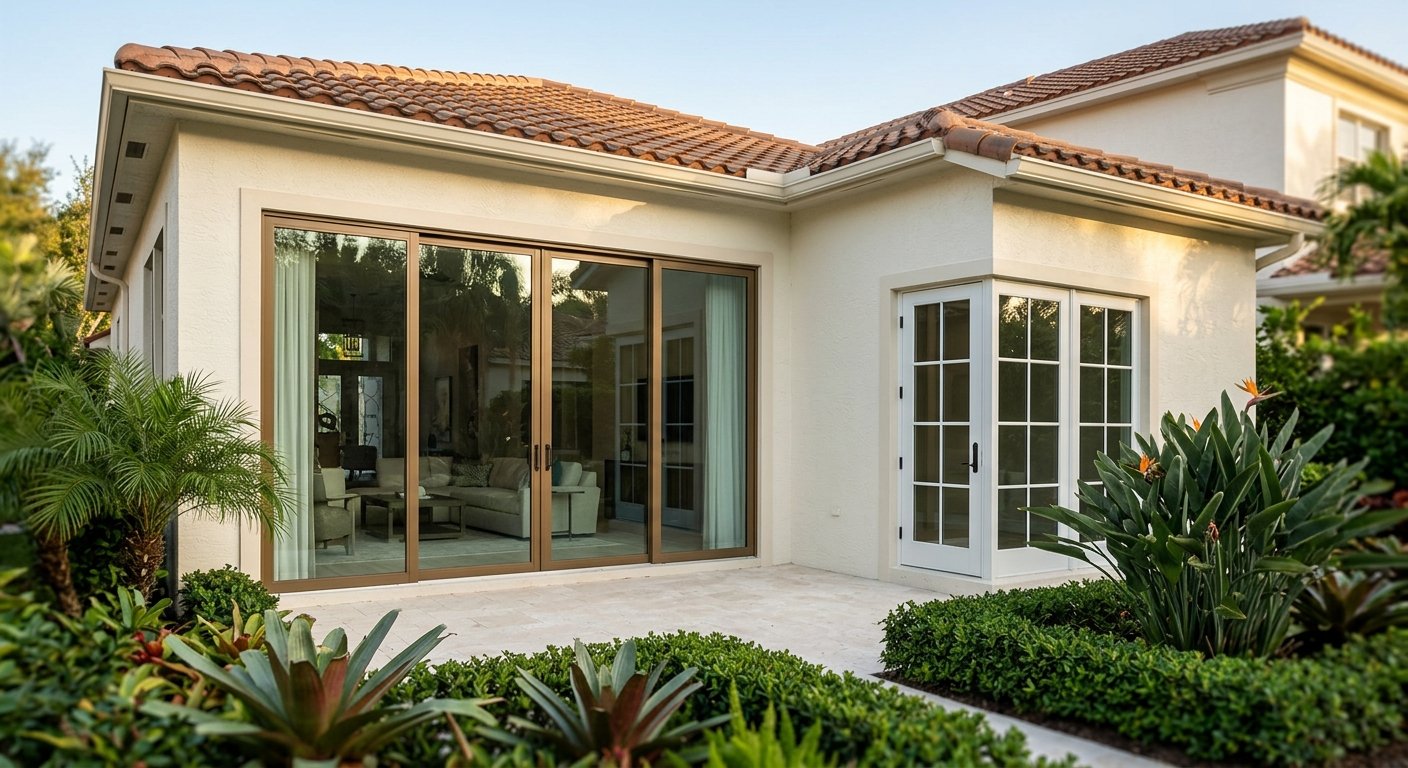
Homeowners focused on noise reduction or energy performance often overlook impact doors as part of the same equation. A sliding glass door covering a large opening on a west-facing lanai contributes more to solar heat gain than a comparably sized window simply because of the square footage involved. The same Low-E glass configurations available in windows are available in our impact door product line, including sliding glass and French door configurations.
Acoustic performance on doors follows the same physics — laminated glass and a properly sealed frame reduce sound transmission through what is often the largest glass opening in a home. If you’re addressing noise from a back patio facing a busy road in Delray Beach or Plantation, the door is as important as the windows.
Frequently Asked Questions
Do impact windows actually reduce noise significantly?
Yes — the laminated interlayer and IGU construction used in quality impact glass packages meaningfully reduce sound transmission compared to single-pane aluminum windows. The degree of reduction depends on the specific glass package; look at the STC rating in the product’s Florida Product Approval documentation for an objective comparison between options.
What is Low-E glass and does it make a visible difference?
Low-E (low-emissivity) coatings are thin metallic layers on the glass surface that reflect infrared heat while passing visible light. They do not significantly affect the appearance of your view or the amount of daylight entering a room. In South Florida’s sunny climate, the impact on interior temperature and cooling load is real and noticeable.
Can I get both noise reduction and energy savings from the same window?
Yes. A laminated insulated glass unit with a Low-E coating performs well on both dimensions. The glass configurations available through CWS and ES Windows — the brands Access Impact installs — include options that address both STC and SHGC performance simultaneously. Your product recommendation will depend on your home’s orientation, existing framing, and county code requirements.
How do I know the energy or acoustic specs are accurate?
Every product we install carries a Florida Product Approval number, which you can verify independently in the Florida Building Commission’s online database. That approval references the test reports establishing the product’s STC and SHGC values. If a contractor can’t provide an approval number, the specs they’re quoting aren’t verified.
Does installation quality affect noise and energy performance?
Significantly. A gap or inadequate seal between the frame and the rough opening creates a flanking path that bypasses the glass’s acoustic performance and undermines energy efficiency through air infiltration. Proper installation — with permitted inspections — is how laboratory specs translate into real-world performance. This is why Access Impact uses in-house crews and carries every job through permit inspection.
Get a free estimate for your home
Access Impact serves Palm Beach County, Broward County, and the Fort Myers–Naples area — licensed Florida General Contractor CGC1525402 and Roofing Contractor CCC1337755, in business since 2007, with a permit passing guarantee on every installation.

About Access Impact
Access Impact is a licensed Florida general contractor (CGC1525402) and roofing contractor (CCC1337755) installing impact windows, impact doors, and roofing across Palm Beach County, Broward County, and Southwest Florida (Lee and Collier) since 2007. In-house crews, Florida Product Approval on every product, and a permit-passing guarantee: the technically authoritative installer, not a volume reseller. Windows and doors are CWS and ES Windows; roofing is CertainTeed, Owens Corning, GAF, Dynamic Metals, Metal Alliance, and Polyglass. Offices in Deerfield Beach and Fort Myers. Visit accessimpact.com →