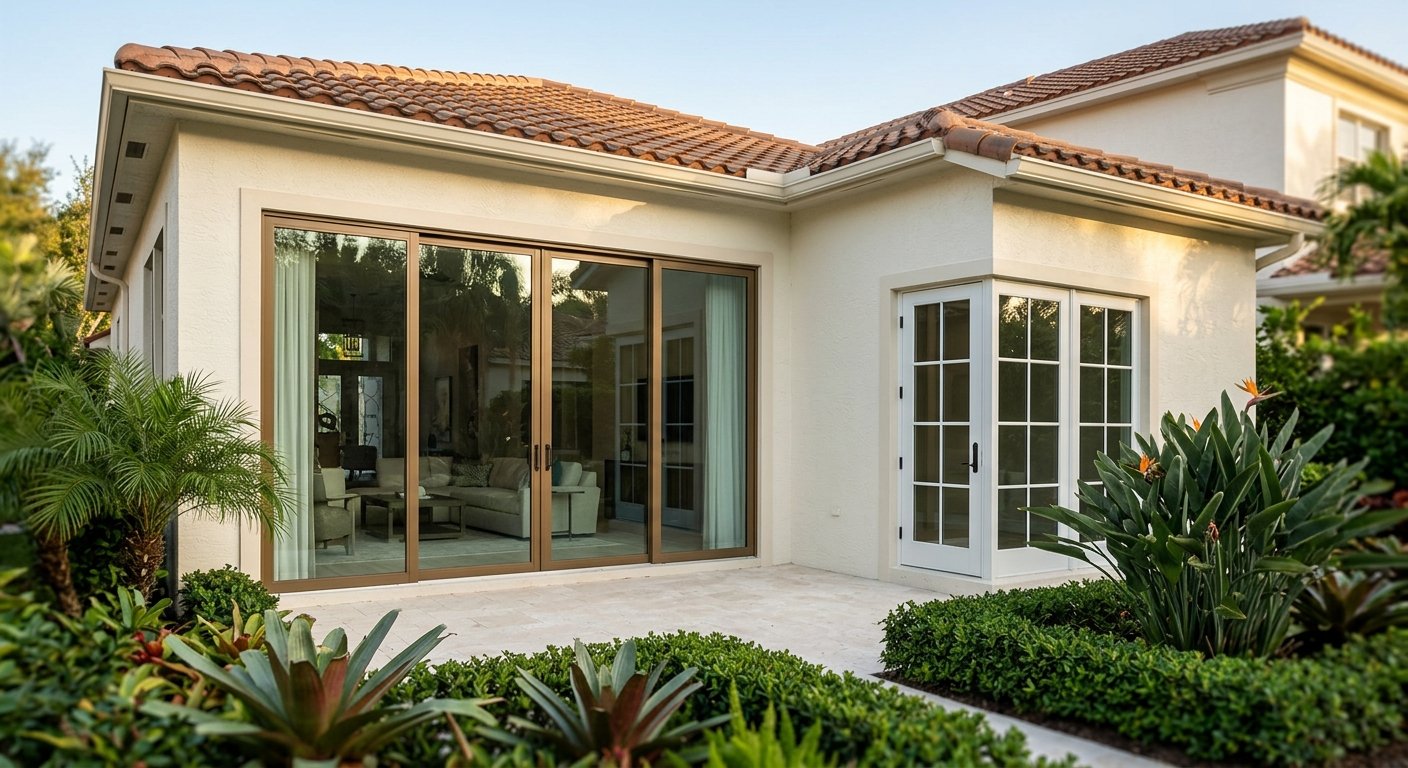
Impact sliding glass doors are laminated-glass patio doors built to meet Florida‘s impact-resistance standards — they replace standard sliders with a product that has a Florida Product Approval (or Miami-Dade NOA), passes permit inspection, and carries the structural performance ratings required under the Florida Building Code. For homeowners in Palm Beach County, Broward County, Lee County, and Collier County, they are the code-required path to replacing an exterior sliding door in a habitable space.
- Every impact sliding door installed in South Florida requires a permit, a Florida Product Approval or Miami-Dade NOA, and a final inspection — no exceptions under the Florida Building Code.
- Laminated glass, not film or shutters, is what earns product approval; the frame, glass, and installation method are all tested together as a system.
- Proper installation — flashing, anchoring, and sill drainage — is as critical as the product itself; code does not distinguish between a bad installation and a bad product at inspection.
- The process from signed contract to completed installation typically runs 10–12 weeks, most of that permit and product lead time.
- Not all contractors carry their own crews; in-house installation matters for accountability when the inspector shows up.
What Makes a Sliding Door “Impact-Rated”
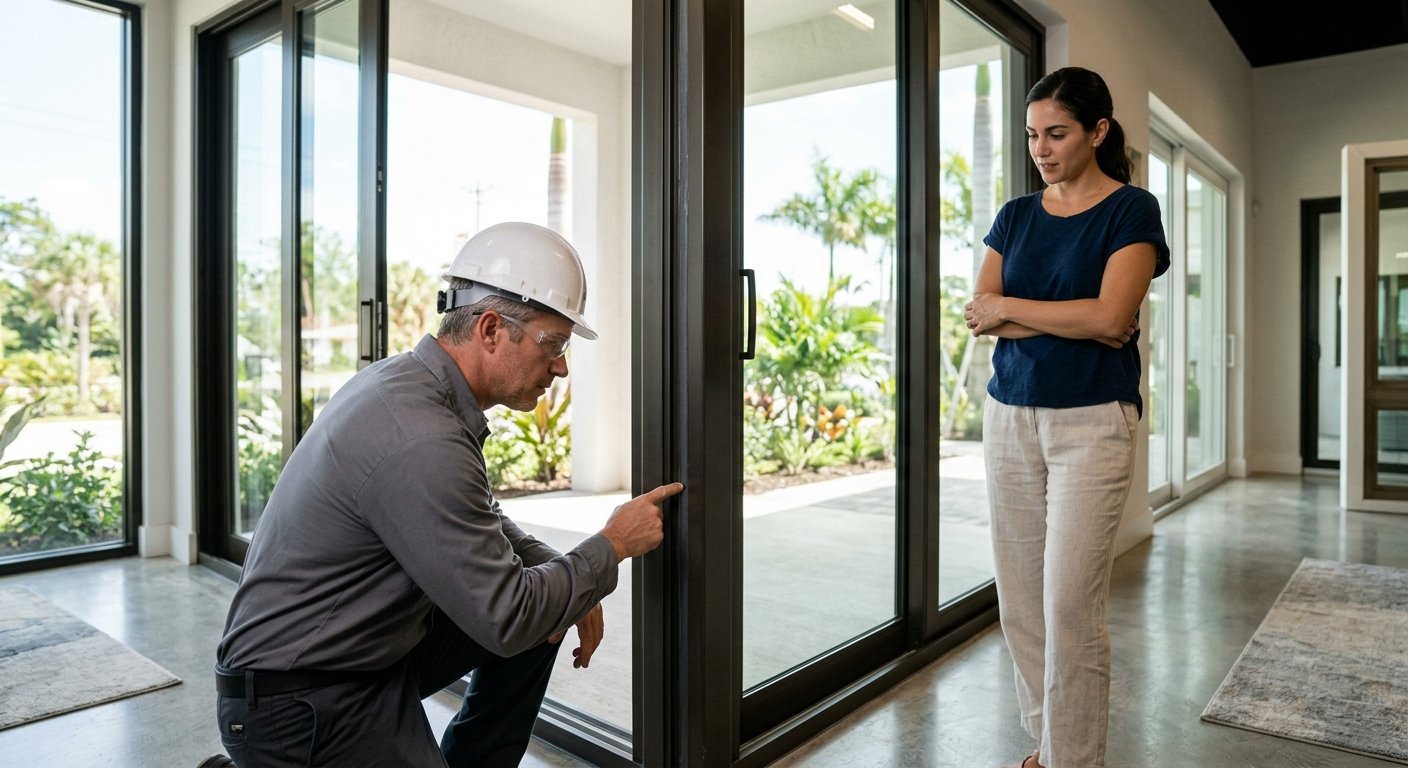
The term gets used loosely in advertising, so it helps to be specific. An impact sliding glass door earns its rating when the complete assembly — frame, glass, hardware, and glazing compound — passes ASTM E1886 and E1996 large-missile and cyclic-pressure testing. Florida then issues a statewide Florida Product Approval (or a Miami-Dade NOA that is accepted statewide) listing exactly what sizes, configurations, and installation conditions that approval covers.
That distinction matters because a door that passed testing in a 6-foot width does not automatically cover an 8-foot or 12-foot configuration. When Access Impact pulls a quote, the product approval number goes on every line item. If a door doesn’t have it, we don’t quote it.
The glass itself is laminated — two glass lites bonded to a polyvinyl butyral (PVB) interlayer. When impacted, the glass may crack but the interlayer holds the pane intact, preventing breach. This is also why laminated impact glass offers meaningful noise reduction: the interlayer interrupts sound transmission in a way that ordinary glass cannot replicate.
Florida Product Approval is issued by the Florida Building Commission and is publicly searchable at floridabuilding.org. Every approval lists the tested configurations, installation type, and maximum design pressure. Asking a contractor for the approval number before signing is a reasonable and informed request.
Florida Building Code Requirements for Patio Door Replacement
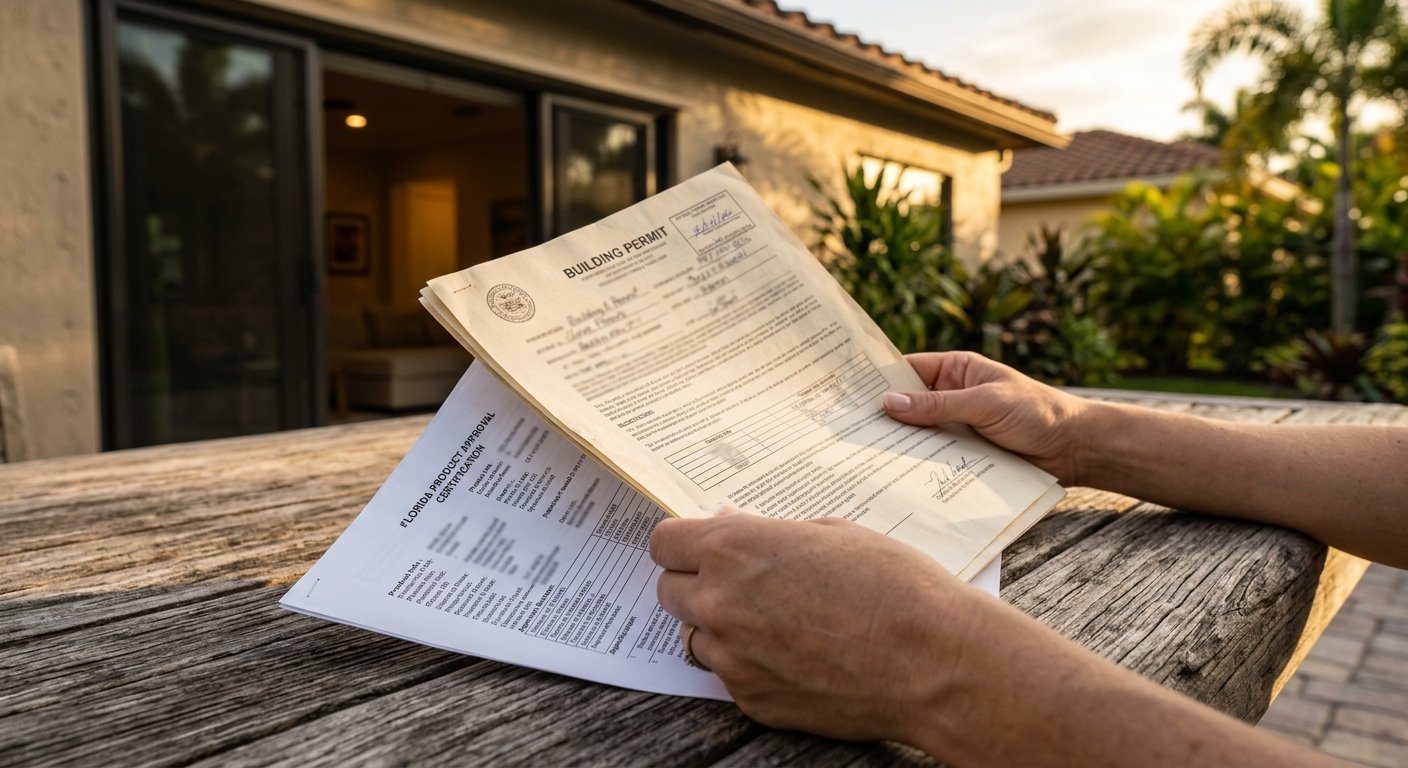
Florida operates under the Florida Building Code (FBC), which adopts and amends the International Building Code on a rolling basis. For impact patio doors in South Florida’s wind zones, the code requires:
- A permit before work begins. No over-the-counter or after-the-fact permits for exterior openings in habitable spaces.
- Florida Product Approval or Miami-Dade NOA on the submitted product. The approval number appears on the permit application.
- Installation per the approval’s installation instructions. Anchoring pattern, substrate type, sill flashing, and buck/rough opening specs are all part of the approval — deviation voids it.
- Final inspection by the authority having jurisdiction (AHJ). In Palm Beach County, Broward County, and Lee and Collier counties, this is typically the county or municipality building department.
Access Impact holds Florida Certified General Contractor license CGC1525402 and Florida Certified Roofing Contractor license CCC1337755. Our permit passing guarantee means we handle the permit application, submit the product approval documentation, and schedule the inspection — and we stand behind the result.
Unpermitted door replacements create title and insurance complications when a home is sold or a claim is filed. In Florida, an unlicensed contractor cannot legally pull a permit on your behalf — and you, as the homeowner, become responsible for code compliance if you pull it yourself without the contractor’s supervision. Verify license status at myfloridalicense.com.
Choosing the Right Configuration
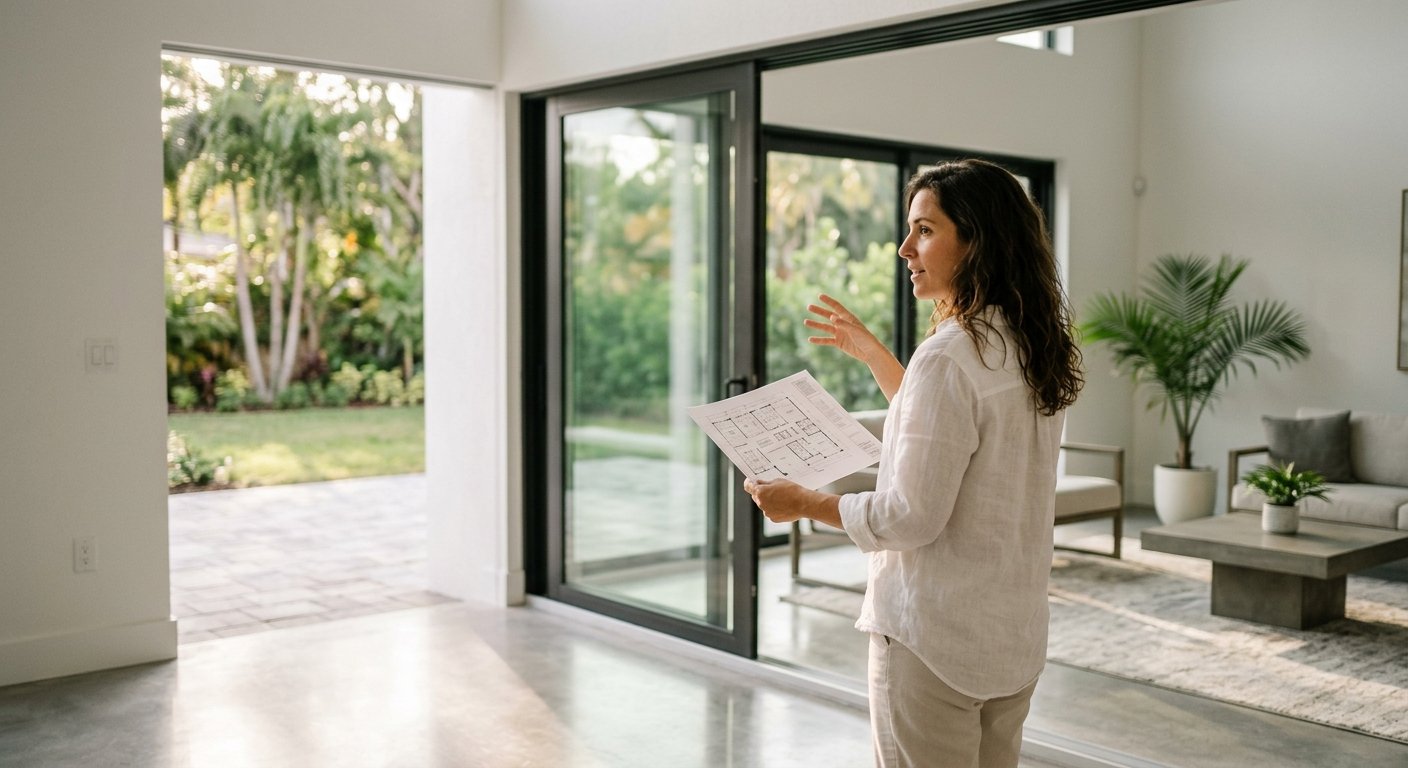
Impact sliding doors in South Florida come in a range of panel configurations. The right choice depends on the rough opening, traffic patterns, and how the door interacts with the floor plan.
| Configuration | Best for | Key consideration |
|---|---|---|
| 2-panel (OX or XO) | Standard openings, 5–8 ft wide | One panel fixed, one sliding — straightforward sill and track requirements |
| 3-panel (OXO) | Wide openings, 9–12 ft | Center panel slides; flanking panels fixed — requires reinforced frame corners |
| 4-panel (OXXO) | Very wide openings, pool lanais | Two sliding panels meet in center; sill drainage design is critical |
| Pocket or bypass | Tight interior clearance | Wall pocket must be framed before installation; structural coordination required |
Access Impact installs CWS and ES Windows impact sliding doors — both lines carry Florida Product Approvals across multiple configurations and design pressures. The appropriate design pressure rating depends on your building’s wind speed exposure, which varies by county and distance from the coast. We specify the correct rating on every project; homeowners in coastal Boca Raton or Fort Myers Beach face different design pressure requirements than those a few miles inland.
What the Installation Process Looks Like
From the day a contract is signed, homeowners should plan for a 10–12 week timeline. Here is where that time goes:
Measure and product selection
We take rough opening dimensions, confirm the substrate (CBS block, wood frame, or steel stud), and select the approved product and configuration. Design pressure and product approval are confirmed at this stage.
Permit application
We submit drawings, product approval documentation, and the permit application to the building department. Review times vary by municipality — Broward County cities often move faster than some Palm Beach jurisdictions, and Fort Myers and Naples have their own timelines.
Product fabrication and delivery
Impact door panels are fabricated to the approved specification after permit issuance. Lead times from CWS and ES Windows are factored into our 10–12 week estimate.
Installation day
Our in-house crews remove the existing door, prep the rough opening, set the buck if required, anchor the new frame per the product approval’s fastener schedule, flash and seal the perimeter, and hang the panels. Sill drainage is tested before the crew leaves.
Final inspection
The inspector from the AHJ reviews the installation against the permit and product approval. Our permit passing guarantee covers this — if there is a correction, we address it.
Why Installation Quality Is Not a Detail
The product approval for an impact sliding door specifies not just the door itself but how it must be anchored. Fastener type, diameter, embedment depth, and spacing are all tested conditions. An anchor pattern that deviates from the approval — even if it “looks fine” — is a code violation that will fail inspection and, more importantly, can compromise the door’s structural performance in the conditions it was rated for.
Sill flashing and drainage are equally exacting. Florida’s water-infiltration test under ASTM E331 is part of product approval testing, and field installation must replicate those conditions. A sliding door sill that traps water instead of draining it creates a long-term moisture problem regardless of how impact-resistant the glass is.
The product approval and the installation are one system — you cannot separate the two at inspection, and you should not separate them when hiring a contractor.
Access Impact uses in-house crews — the same people who measure, permit, and install every project. There are no day-labor subcontractors handed a set of plans on installation day. For homeowners in Deerfield Beach, Plantation, Coral Springs, or Cape Coral, that continuity is what connects the permit drawings to the finished installation.
What to Ask Before You Sign a Contract
- What is the Florida Product Approval number for the door you’re quoting, and does it cover my exact opening size?
- Are you licensed as a Florida Certified General Contractor? What is your license number?
- Will you handle the permit application and inspection scheduling?
- Will your own crews install the door, or do you subcontract the labor?
- What is the anchoring substrate at my opening, and does the product approval cover it?
These are not adversarial questions — any technically qualified installer will answer them without hesitation. For further guidance on the full range of impact door types, including French and pivot configurations, the impact door installation page covers the broader category in detail.
Frequently Asked Questions
Do impact sliding glass doors require a permit in Palm Beach and Broward counties?
Yes. Any exterior door replacement in a habitable space requires a permit under the Florida Building Code, regardless of county. The permit requires a Florida Product Approval or Miami-Dade NOA for the specific product installed, and a final inspection by the local building department before the permit is closed.
How long does impact patio door installation take from start to finish?
From signed contract to completed installation, plan for 10–12 weeks. Most of that time is permit review and product fabrication — actual installation day is typically a single day for a standard two- or three-panel slider. Timelines vary by municipality and product configuration.
Can I install an impact sliding door over an existing track without replacing the frame?
No. The Florida Product Approval covers the complete assembly — frame, glass, hardware, and anchoring. Reusing an existing frame with new panels is not a tested or approved configuration and will not pass inspection. The rough opening must be prepared and the approved system installed as a unit.
What is the difference between impact doors in Broward County versus Palm Beach County requirements?
The Florida Building Code applies statewide, so the performance standards are the same. What differs is the local wind speed design pressure required for your specific location within each county — coastal areas carry higher design pressures than inland zones. The municipality’s building department may also have supplemental requirements. We specify the correct design pressure on every quote.
Are impact sliding doors also good for noise reduction?
Yes, as a practical secondary benefit. The laminated glass construction — two lites bonded to a PVB interlayer — significantly interrupts sound transmission compared to single-pane or standard double-pane glass. Homeowners near busy roads, airports, or Intracoastal waterways in Fort Lauderdale, Boca Raton, or Naples frequently note the difference. Noise reduction is a result of the construction, not a separately rated specification on most residential products.
Get a quote on impact sliding door installation
Access Impact installs impact patio doors across Palm Beach County, Broward County, and Southwest Florida — permitted, product-approved, and inspected by our in-house crews. Contact us for a free estimate.

About Access Impact
Access Impact is a licensed Florida general contractor (CGC1525402) and roofing contractor (CCC1337755) installing impact windows, impact doors, and roofing across Palm Beach County, Broward County, and Southwest Florida (Lee and Collier) since 2007. In-house crews, Florida Product Approval on every product, and a permit-passing guarantee: the technically authoritative installer, not a volume reseller. Windows and doors are CWS and ES Windows; roofing is CertainTeed, Owens Corning, GAF, Dynamic Metals, Metal Alliance, and Polyglass. Offices in Deerfield Beach and Fort Myers. Visit accessimpact.com →